SB 1213: What changed Nov. 1 in Oklahoma's earned credits for county jail days and class levels
SB 1213 took effect Nov. 1, 2026: Oklahomans held in county jail awaiting prison now earn 1.47 credits a day, and Class 3 and 4 waits are gone.
By OutSooner editorial team · Published · Updated · Checked against the official source on · Oklahoma updates
Legal status checked Nov 2, 2026
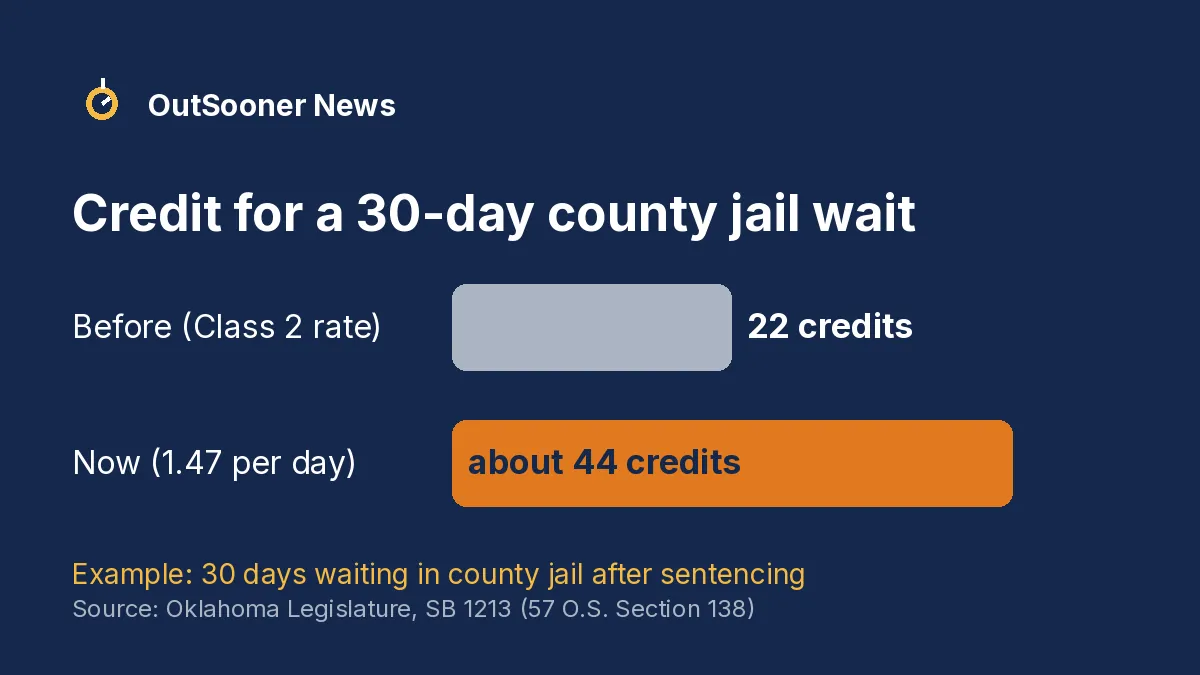
A person sentenced to an Oklahoma prison term does not always go to prison right away. Many wait in a county jail until the state Department of Corrections has room to take them in at a reception center. Until Nov. 1, those weeks or months earned credits at a fixed rate of 22 a month.
That changed on Nov. 1, 2026, when Senate Bill 1213 took effect. Under the new law, people held in county jail because of the department's reception scheduling now earn 1.47 credits per day. As before, that time is counted from the date of their judgment and sentence. One credit equals one day.
The arithmetic is simple. Thirty days at the new rate comes to about 44 credits, double the 22 a person would have earned in the same month at the old Class 2 rate. That is an illustration, not a forecast for any individual case.
The law does not stop at the jail. It also removes the minimum time in custody that Oklahoma had required before someone could reach the two highest credit levels.
What SB 1213 changed on Nov. 1
SB 1213 amends Title 57, Section 138 of the Oklahoma Statutes, the section that governs earned credits. The Senate passed it 46-0 on March 16, 2026. The House passed it 87-2 on May 6, and the governor approved it May 12, according to the Legislature's bill history and LegiScan. It was written by Sen. Rader, with Sen. Nikki Nice, D-Oklahoma City, as a Senate coauthor; Rep. Harris is the principal House author. Section 2 of the enrolled text sets the effective date: "This act shall become effective November 1, 2026."
Two provisions matter most.
The jail rate. The enrolled text says people "detained in a county jail as a result of the Department's reception scheduling procedure" earn credits "at a rate of 1.47 credits per day." There is an exception. A person convicted of a misdemeanor or felony committed in the jail while waiting for transport to the Lexington Assessment and Reception Center, or another reception site, does not get the jail-wait credits.
The waiting periods. Before the change, Class level 3 required that a person had been incarcerated at least three months, and Class level 4 required at least eight months, on top of evaluation standards. The law deletes those time requirements. It does not delete the evaluations. Class 3 still calls for excellent work, education or program evaluations and an excellent evaluation for hygiene and living-area upkeep. Class 4 still calls for outstanding ratings in the same areas.
Nobody moves up a level automatically. An adjustment review committee still assigns class levels and reviews them at least once every four months.
What stayed the same
Much of Section 138 is untouched. The monthly credit rates for each class remain where they were. For people ever convicted as an adult or youthful offender, or adjudicated delinquent as a juvenile, for an offense listed in subsection E of Section 138, the rates are 0, 22, 33 and 44 credits per month for Classes 1 through 4. For people never convicted as an adult or youthful offender, or adjudicated delinquent as a juvenile, for an offense listed in subsection E of Section 138, they are 0, 22, 45 and 60.
Credits still reduce only the maximum term of a sentence. They still do not apply to life sentences or to crimes that killed an officer or corrections employee in the line of duty. Credits can still be taken away for misconduct, and restored.
Achievement credits for finishing approved programs are also unchanged: 200 for a bachelor's degree, 100 for an associate degree, 90 for a high school diploma or GED, 80 for a vocational certificate, 70 for completing a four-month substance abuse program, and 10 to 30 for other approved programs. A diploma earned in jail counts if it appears on the jail sentence form.
The question the law leaves open
SB 1213 does not say whether credits earned before Nov. 1 will be recalculated, either for jail time already served or for people who were held below Class 3 or 4 only because of the old time requirements. The text is silent. As of Nov. 2, the Department of Corrections' posted policies had not been updated for the new law: its class-level procedure, OP-060107 (opens in new tab), effective Sept. 1, 2026, still describes the old Class 2 jail rate and the three-month wait for Class 3. OutSooner did not find a department statement on how it will treat time served before Nov. 1.
Families who want to know how the law applies to someone already in custody should ask the facility's records office or the Department of Corrections directly. The department lists ways to reach it on its contact page (opens in new tab), and its offender information page (opens in new tab) links to its offender lookup and family resources. A lawyer can advise on a specific case.
Running the numbers
OutSooner's Oklahoma release date calculator applies the new rate of 1.47 credits per day only to jail days on or after Nov. 1, 2026, because the law does not say how earlier days count, and its result is not an official calculation. The Oklahoma earned credits guide, which explains each credit type, keeps its broader estimates paused until the department says how it is applying the law. OutSooner tracks this and other Oklahoma bills in its Oklahoma bill tracker, and what happens next and the family action plan cover the steps after sentencing.
Only the Oklahoma Department of Corrections calculates official release dates.
Related
Updates: if this article changes after publication, an "Updated [date]" note will appear here describing what changed, and the page's modified date will match it. No updates so far.
How we report: OutSooner editorial standards. This article explains a change in law and is not legal advice.
OutSooner is a free information site, not a law firm and not a government site. This is general information, not legal advice. Only the Oklahoma Department of Corrections calculates official parole eligibility and release dates.
Sources
- Oklahoma Legislature, SB 1213 bill information, checked Nov. 2, 2026 (opens in new tab)
- Oklahoma Legislature, SB 1213 enrolled text (PDF), checked Nov. 2, 2026 (opens in new tab)
- Oklahoma Department of Corrections, OP-060107 (class-level procedure, effective Sept. 1, 2026), checked Nov. 2, 2026 (opens in new tab)
- LegiScan, OK SB1213, 2026 Regular Session, data pulled Nov. 2, 2026 (opens in new tab)
- Oklahoma State Courts Network, 57 O.S. § 138, Inmate Credit - Class Level, checked Nov. 2, 2026 (opens in new tab)
Rules and fees change. Always check the official source before you send money or travel. Spot a mistake? Report an error.
How we verified this page
- Sources checked: the official sources linked here were last checked on the date below.
- Rules compared: our explanation is compared with those sources. It is not a legal review or legal advice.
- Errors: if anything doesn't match the official source, tell us on the Corrections page.
Sources: How we source and verify · Corrections
Methodology · Data quality · Privacy · Editorial & source review
General information, not legal advice. OutSooner is not a law firm or a government agency. Laws and rules change; check the official source linked on each page before you act. Full disclaimer →