Nevada's 35% sentence credit law, delayed twice, now starts July 1, 2027. Here's who it covers
Nevada's 35% good-behavior credit method, delayed twice, now starts July 1, 2027. Who it covers, who can choose it, and what to ask NDOC.
By OutSooner editorial team · Published · Updated · Checked against the official source on · Nevada updates
Legal status checked Nov 2, 2026
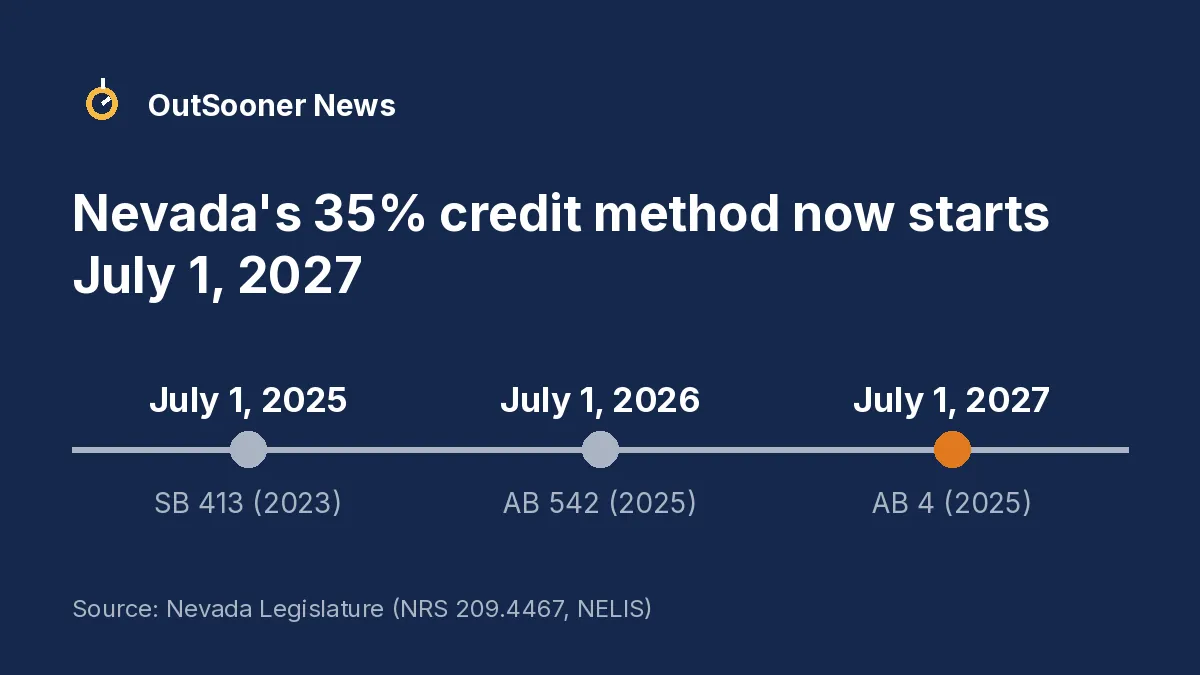
Nevada lawmakers wrote a new way to count good-behavior credit in 2023 and gave it a start date of July 1, 2025. That date has since been moved twice. Under the law as it stands today, the new method begins July 1, 2027.
For families tracking a parole eligibility date, the delay matters because the new method works differently from the one in use now. Instead of earning credit month by month, a person would be credited with a fixed share of the sentence: 35%.
What the new method does
The method lives in NRS 209.4467, a section the Nevada Legislature's online statutes mark "[Effective July 1, 2027.]" It has two parts.
The first is credit against the minimum term, the part of the sentence that controls when someone becomes eligible for parole. The statute allows good-behavior credit equal to 35% of the minimum term, counted only for time actually spent incarcerated on the sentence.
That credit is not available to everyone. Under NRS 209.4467(1), it "does not apply to an offender who has been convicted of: (a) Any crime that is punishable as a felony involving the use or threatened use of force or violence against the victim. (b) A sexual offense that is punishable as a felony. (c) A violation of NRS 484C.110, 484C.120, 484C.130 or 484C.430 that is punishable as a felony. (d) A category A or B felony."
The second part is credit against the maximum term, also equal to 35%. It has no list of excluded offenses. It counts time actually incarcerated, time in residential confinement, and time in certain Division of Parole and Probation programs, and it comes on top of credits other statutes allow.
On both terms, the Director of the Department of Corrections may allow up to 90 more days a year for "exceptional meritorious service."
The law also ties credit to programming. The Department must give each person a list of the programs identified in their risk and needs assessment and which of those are offered where they are held, and must report to the parole board which ones they completed. The rules the Board of State Prison Commissioners adopts under the section must require credits to be forfeited if a person does not comply with the programming and placement in that assessment.
How the date kept moving
Senate Bill 413 created the method in 2023, with a July 1, 2025, start. In 2025, Assembly Bill 542 pushed the start to July 1, 2026. Its legislative digest says the bill also added the meritorious-service credit and required the department to give information to people before they choose the new method.
Then came Assembly Bill 4 from the Legislature's 36th Special Session, also in 2025. According to its digest, sections 58.2 through 58.7 "further delay the implementation of the revised method to July 1, 2027." AB 4 as a whole took effect Jan. 1, 2026. Its section 58.7 sets July 1, 2027, as the start date for the new credit method, while letting the government adopt regulations and do other preparation before then.
None of the official sources we reviewed gives a reason for either delay. OutSooner is not offering one.
Who it covers, and who gets a choice
People sentenced for a crime committed on or after July 1, 2027, fall under the new method.
People sentenced for a crime committed before that date may choose it. The election is irrevocable, and it applies to both the minimum-term and maximum-term calculations at once; a person cannot take the new method for one and keep the old method for the other. Before anyone decides, the Department must give them a written projection comparing their estimated credit under each method.
AB 4 added a group the earlier version of this story did not describe. A person in Department custody for a crime committed before July 1, 2027, who is within two years of completing their minimum or maximum term on or after that date "is subject to the provisions of this section" and may make the same irrevocable election, according to the statute. The AB 4 digest says the Director must calculate those people's credit using the new method. The statute adds that if a person "becomes eligible for release on parole before the eligible date of release calculated pursuant to this section, the Director may authorize the offender to be considered early for parole or release the offender consistent with the calculation of credit under the irrevocable waiver, as applicable." That decision is up to the Director. The law does not guarantee early parole consideration or release.
The statute also says it should not be read to reduce credit retroactively if doing so would violate the U.S. or Nevada constitution.
As of Nov. 2, 2026, the Department's 2026 news page had no announcement about the new method. The credit regulations posted on its site, AR 563 and AR 564, both took effect in 2012, before this law. The law requires the Board of State Prison Commissioners to adopt rules for the new credits. OutSooner did not find any adopted rules on the Department's or the parole board's websites.
What hasn't changed yet
Until July 1, 2027, the current credit statute still applies. For crimes committed on or after July 17, 1997, but before July 1, 2027, NRS 209.4465 allows a deduction of 20 days for each month served by someone with no serious infraction, plus up to 10 more days a month that the Director may grant for diligence in labor and study, along with set credits for a GED, diploma or associate degree.
OutSooner's Nevada release date calculator shows how these credits work, step by step, with the rule behind each one. The Nevada sentence credit guide explains SB 413 and the 35% method in more detail. Any estimate is a starting point. Only the Nevada Department of Corrections calculates official parole eligibility and release dates.
What families can do
- Write down the offense date on the judgment of conviction. Whether it falls before or after July 1, 2027, decides which rules apply.
- If your loved one's offense was committed before July 1, 2027, you can ask the facility's caseworker or records staff when the department will provide the written comparison that the law requires before any election. The law says that election is irrevocable.
- You can ask the facility's caseworker which programs are listed in your loved one's risk and needs assessment. The law says the Board's rules for the new method must require credits to be forfeited if a person does not comply with the programming and placement in that assessment. Those rules have not been posted yet.
- Check this page or the Nevada guide for changes. A future legislative session could change the date again.
- For advice about a specific case, talk to a lawyer.
Updated Nov. 2, 2026: Rewritten and re-checked against the statute and enrolled bills on Nov. 2, 2026. Added the two-year group created by AB 4, the program-list and forfeiture rules, the retroactivity clause and the current 20-day rule. Byline changed to OutSooner editorial team.
How we report: OutSooner editorial standards. This article explains a change in law and is not legal advice.
More on Nevada's new credit law
OutSooner is a free information site, not a law firm and not a government site. This is general information, not legal advice. Only the Nevada Department of Corrections calculates official parole eligibility and release dates.
Sources
- NRS 209.4467 (Nevada Legislature) (opens in new tab)
- SB 413 (2023) on NELIS (opens in new tab)
- AB 542 (2025) on NELIS (opens in new tab)
- AB 542 enrolled text (PDF) (opens in new tab)
- AB 4, 36th Special Session (2025) on NELIS (opens in new tab)
- AB 4 enrolled text (PDF) (opens in new tab)
Rules and fees change. Always check the official source before you send money or travel. Spot a mistake? Report an error.
More help in your state
How we verified this page
- Sources checked: the official sources linked here were last checked on the date below.
- Rules compared: our explanation is compared with those sources. It is not a legal review or legal advice.
- Errors: if anything doesn't match the official source, tell us on the Corrections page.
Sources: How we source and verify · Corrections
Methodology · Data quality · Privacy · Editorial & source review
General information, not legal advice. OutSooner is not a law firm or a government agency. Laws and rules change; check the official source linked on each page before you act. Full disclaimer →