California proposes 2 weeks of milestone credit for peer support training
California proposes 2 weeks of milestone credit for peer support training. Not yet adopted; comments due Nov. 23. What it means for families.
By OutSooner editorial team · Published · Updated · Checked against the official source on · California updates
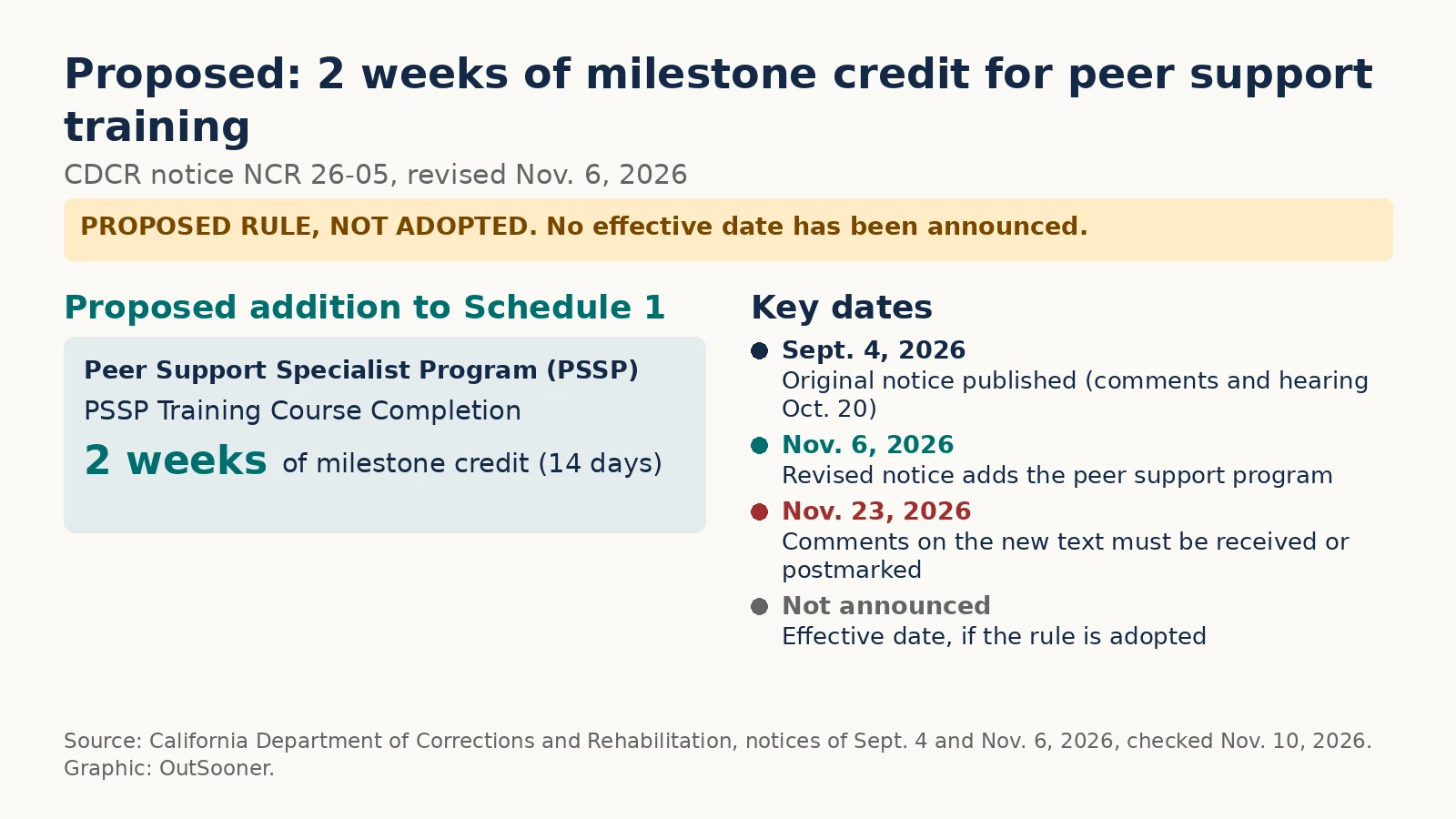
California's corrections department has proposed adding its Peer Support Specialist Program to the list of programs that earn milestone credit, with 2 weeks of credit for completing the training course. The change is in a revised rule notice dated Nov. 6, 2026, and comments on the new text are due Nov. 23, 2026.
This is a proposed rule, not an adopted one. The California Department of Corrections and Rehabilitation (CDCR) has not announced an effective date.
What the Nov. 6 notice changes
CDCR's revised notice for NCR 26-05 (opens in new tab) amends the proposed Milestone Completion Credit Schedule, which California Code of Regulations, Title 15, section 3043.3 incorporates by reference. It proposes two changes to Schedule 1, the list run by the Division of Rehabilitative Programs:
- A new program. The CDCR/CCHCS Peer Support Specialist Program (PSSP) would be added. The proposed schedule lists PSSP Training Course Completion at 2 weeks. The notice describes the program as training incarcerated people to use their shared life experiences to help others with rehabilitation, recovery and adjustment to prison life.
- The legend would be put back. The notice says the legend explaining the codes on Schedule 1 was left off the Sept. 4 proposed text by a clerical error. The revised text restores it without the Schedule 1 code R7, which the department says is no longer relevant. The current schedule already has a legend, and the Schedule 2 legend is not changed.
The proposed schedule carries a new revision label, Rev. 01/27. That is a version label, not an effective date. The current schedule is Rev. 01/26 (opens in new tab), which CDCR lists as taking effect Jan. 27, 2026.
How we got here
CDCR published the original notice (opens in new tab) on Sept. 4, 2026. It set a public hearing and the close of comments for Oct. 20, and that comment period has ended. The original proposal covers more than the peer support program. The department's initial statement of reasons describes additions, revisions and removals across the schedule, including adding construction mentorship courses and removing credit for some current programs. It says the criminal thinking and anger management courses are no longer provided, and it would remove the cognitive behavioral intervention completion entries. These are proposals; none has been adopted.
The Nov. 6 notice says only comments about the text marked as changed in that notice will be considered. CDCR lists the rule on its pending regulations page (opens in new tab).
How to comment by Nov. 23
Comments on the revised text must be received or postmarked by Nov. 23, 2026. They can go by email to RPMB@cdcr.ca.gov or by mail to the Regulation and Policy Management Branch, California Department of Corrections and Rehabilitation, P.O. Box 942883, Sacramento, CA 94283-0001.
What milestone credit is
Milestone completion credit is time taken off a sentence for finishing an approved rehabilitative or educational program. CDCR says it is awarded for programs (opens in new tab) meant to prepare people for work after release.
Under the regulation, the credit moves up the release date for someone with a determinate sentence. For someone with an indeterminate sentence that includes the possibility of parole, it moves up the initial parole hearing date. Credit comes in steps of at least one week and no more than 12 weeks in a 12-month period, and a week counts as seven days. Credit above that limit is awarded on the person's next credit anniversary.
What 2 weeks could mean in the calculator
Two weeks of credit is 14 days. OutSooner's release date calculator lets you choose California, but it has no milestone credit field. The closest input is Credit days already awarded, which asks for good time or earned time on the person's record. The calculator gives an estimate, not an official date. Only CDCR calculates official release dates.
Credit should be entered there only once it shows up on the person's official record. The peer support credit is only proposed, so it would not be on anyone's record under the current schedule. Our California good time guide and guide to checking a California time computation explain California's credit rules.
Credit has limits
A listing on the schedule does not mean everyone gets the credit. Some limits in the regulations:
- Only people who are eligible for good conduct credit can earn milestone credit. The good conduct credit rule says no credit is awarded to a person sentenced to death or to life without the possibility of parole.
- Credit can't move a determinate release date closer than 15 days from the day it is entered. The gap is 45 days for people convicted of certain listed offenses and 60 days for people serving a term for a violent felony.
- Credit can be forfeited after a serious rule violation, once good conduct credit is used up.
- The person has to complete the program. The regulation says passing an exam alone doesn't qualify.
The text of these rules is on the Legal Information Institute's copies of section 3043.3 (opens in new tab), section 3043.2 (opens in new tab) and section 3043 (opens in new tab). These are unofficial copies, and the section 3043.3 copy still lists the older schedule (Rev. 05/24). CDCR's adopted text for the January 2026 change (opens in new tab) says subsections (a) through (c) and (e) through (h) of section 3043.3 did not change. The official text is in the California Code of Regulations.
What to watch
The notices don't say when CDCR expects to decide. The original notice says that if the department modifies the text, it will make the changes public for at least 15 days before adopting them. Families can check the pending regulations page and our California guide and California updates for changes.
OutSooner is a free information site, not a law firm and not a government site. This is general information, not legal advice, and the proposal could change before it is adopted. Read more about how OutSooner reports and corrects stories.
Sources checked Nov. 12, 2026, 6:11–6:13 a.m. MT: CDCR notice NCR 26-05 (Sept. 4, 2026) and revised notice (Nov. 6, 2026); CDCR pending regulations, recently adopted regulations (opens in new tab) and appendices pages; CDCR Milestone Completion Credit Schedule (Rev. 01/26); CDCR credit-earning page; California Code of Regulations, Title 15, sections 3043, 3043.2 and 3043.3.
Rules and fees change. Always check the official source before you send money or travel. Spot a mistake? Report an error.
More help in your state
How we verified this page
- Sources checked: the official sources linked here were last checked on the date below.
- Rules compared: our explanation is compared with those sources. It is not a legal review or legal advice.
- Errors: if anything doesn't match the official source, tell us on the Corrections page.
Sources: How we source and verify · Corrections
Methodology · Data quality · Privacy · Editorial & source review
General information, not legal advice. OutSooner is not a law firm or a government agency. Laws and rules change; check the official source linked on each page before you act. Full disclaimer →