California plans to commute all death sentences: what changes and what doesn't
California plans to change all 548 death sentences to life without parole. No one would be released. What changes, what doesn't and what's pending.
By OutSooner editorial team · Published · Updated · Checked against the official source on · California updates
Legal status checked Nov 9, 2026 · Pre-publish re-check 10:01–10:03 a.m. MT
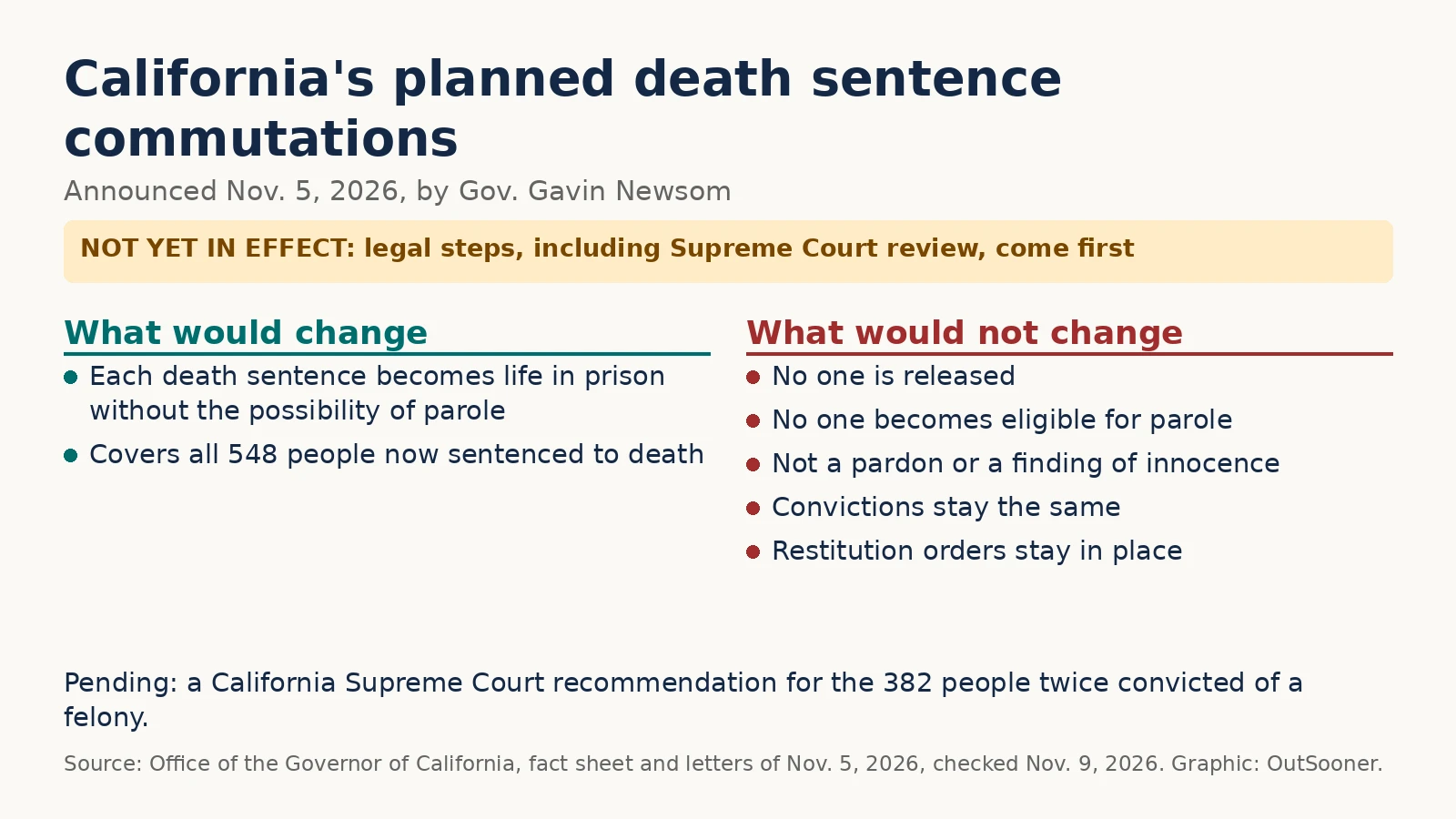
California Gov. Gavin Newsom announced on Nov. 5, 2026, that he plans to change every death sentence in the state to life in prison without the possibility of parole. The change would not release anyone or make anyone eligible for parole, and it has not taken effect yet.
The governor's clemency page (opens in new tab) says the commutations "will not go into effect until the necessary legal steps are completed." For 382 of the people affected, one of those steps is a recommendation from the California Supreme Court. The governor has asked the court for it, and that request is pending.
What the governor announced
In an open letter to Californians (opens in new tab) dated Nov. 5, the governor wrote that he has "decided to exercise my constitutional clemency authority to commute all California death sentences to life without the possibility of parole." He wrote that he will "issue the same commutation to every condemned person."
The governor's fact sheet (opens in new tab) says 548 people are currently sentenced to death in California: 529 men and 19 women. It says the state's last execution took place on Jan. 17, 2006. The governor ordered a moratorium on executions in 2019, but that left the death sentences in place.
In his letter, the governor said he believes "state-sanctioned killing is incompatible with California's values." He also wrote that the action "will anger and hurt some Californians."
What would change
Only the sentence. Each death sentence would become a sentence of life imprisonment without the possibility of parole. The governor's explanatory statement to the Supreme Court (opens in new tab) says the commutation "will apply only to the death sentence imposed" and "will leave in place all restitution orders."
What would not change
The fact sheet lists what the commutations would not do:
- No release. The people affected would remain in prison.
- No parole. The commutations would not make anyone eligible for parole.
- No pardon. They would not be pardons, exonerations or findings of innocence.
- Same convictions. The underlying convictions would not change.
- Restitution stays. Restitution orders would not be erased.
The fact sheet also says no major operational change is expected at the California Department of Corrections and Rehabilitation. It says the state already closed the physical death row at San Quentin and moved people with death sentences into the broader prison system. According to the fact sheet, housing decisions are based on classification and security, and the commutations would not require changes to those housing assignments.
The parole board's new review process doesn't apply
New Board of Parole Hearings regulations took effect Oct. 1, 2026, though the board says they will take time to put in place. They set up a process for the board to recommend some people who have served long sentences for a commutation or resentencing. The fact sheet says the people covered by the governor's action are "specifically excluded" from that process.
The board's FAQ on the new process (opens in new tab), updated Nov. 5, says the same. Anyone who has already received a commutation during their current term is not eligible. The board's rules already excluded people sentenced to death.
Why the Supreme Court is involved
Article V, section 8 of the California Constitution (opens in new tab) gives the governor the power to grant commutations. It also says the governor "may not grant a pardon or commutation to a person twice convicted of a felony except on recommendation of the Supreme Court, 4 judges concurring."
In a letter to the court (opens in new tab) dated Nov. 5, the governor asked for that recommendation for the 382 people under a death sentence who have more than one felony conviction. The explanatory statement says staff checked felony convictions both in California and in other places to build that list. The letter asks the court to issue its recommendation by the end of this year so the governor can act before his term ends. Whether and when the court acts is up to the court.
What families can do now
Don't expect a release or a parole hearing. If it takes effect, the planned change would not lead to a release date or parole eligibility.
Check the posted lists. The governor's clemency page has posted the list of intended clemency recipients, along with a separate list of the people whose cases need the court's recommendation.
Ask the person's lawyer about their case. The governor wrote that the action "will bring to a close these capital cases." The official documents we reviewed don't explain what the change would mean for appeals or other court cases still underway. If the person has an attorney on an appeal or other court case, that attorney is the right person to ask.
Expect restitution to continue. Restitution orders stay in place. Our guide to California restitution deductions explains how they work.
Watch for the effective date. The governor's clemency page (opens in new tab) is where official updates have been posted. The page says victims registered with CDCR's Office of Victim and Survivor Rights and Services will be notified when the commutations go into effect. Victims, survivors and next of kin in these cases can reach that office at 1-877-256-6877 or victimservices@cdcr.ca.gov.
Staying in touch
The fact sheet says the commutations wouldn't require housing changes. These guides can help families keep in contact:
- How to find someone in a California prison
- California prison visit checklist
- California prison mail and photo rules
OutSooner is a free information site, not a law firm and not a government site. This is general information, not legal advice. The governor's action is pending, and details may change as it moves forward. Read more about how OutSooner reports and corrects stories.
Sources checked Nov. 9, 2026, 10:01–10:03 a.m. MT: Office of the Governor clemency page, Nov. 5 announcement, fact sheet, open letter, letter to the California Supreme Court and explanatory statement; Board of Parole Hearings FAQ revised Nov. 5, 2026; CDCR Office of Victim and Survivor Rights and Services notice of Nov. 5, 2026; California Constitution, article V, section 8.
Related
OutSooner is a free information site, not a law firm and not a government site. This is general information, not legal advice. The governor's action is pending, and details may change as it moves forward. Only California's courts and CDCR control official case status.
Sources
- Office of the Governor of California, Clemency page, checked Nov. 9, 2026 (opens in new tab)
- Office of the Governor, Nov. 5, 2026 announcement on the death penalty, checked Nov. 9, 2026 (opens in new tab)
- Office of the Governor, External Fact Sheet — Clemency Action (PDF), Nov. 5, 2026, checked Nov. 9, 2026 (opens in new tab)
- Office of the Governor, Open Letter on the death penalty (PDF), Nov. 5, 2026, checked Nov. 9, 2026 (opens in new tab)
- Office of the Governor, Letter to the California Supreme Court (PDF), Nov. 5, 2026, checked Nov. 9, 2026 (opens in new tab)
- Office of the Governor, Explanatory Statement (PDF), Nov. 5, 2026, checked Nov. 9, 2026 (opens in new tab)
- Board of Parole Hearings, Commutation and Resentencing Process FAQs (PDF), revised Nov. 5, 2026, checked Nov. 9, 2026 (opens in new tab)
- California Constitution, article V, section 8, checked Nov. 9, 2026 (opens in new tab)
Rules and fees change. Always check the official source before you send money or travel. Spot a mistake? Report an error.
More help in your state
How we verified this page
- Sources checked: the official sources linked here were last checked on the date below.
- Rules compared: our explanation is compared with those sources. It is not a legal review or legal advice.
- Errors: if anything doesn't match the official source, tell us on the Corrections page.
Sources: How we source and verify · Corrections
Methodology · Data quality · Privacy · Editorial & source review
General information, not legal advice. OutSooner is not a law firm or a government agency. Laws and rules change; check the official source linked on each page before you act. Full disclaimer →