BOP says all federal prisons are now eligible to run its VITAL veterans program
BOP says all its institutions are now eligible to run VITAL, a veterans-only reentry program. What it covers, what's unclear, and what families can ask.
By OutSooner editorial team · Published · Updated · Checked against the official source on
The Federal Bureau of Prisons (BOP) says all of its institutions are now eligible to implement VITAL, short for Veterans In Transition Achieving Learning. BOP describes it as a nonresidential, veteran-only reentry program, and announced the change in a news story it marked as updated Nov. 10, 2026.
The words "eligible to implement" are BOP's. The announcement does not say which prisons have started VITAL or when any will.
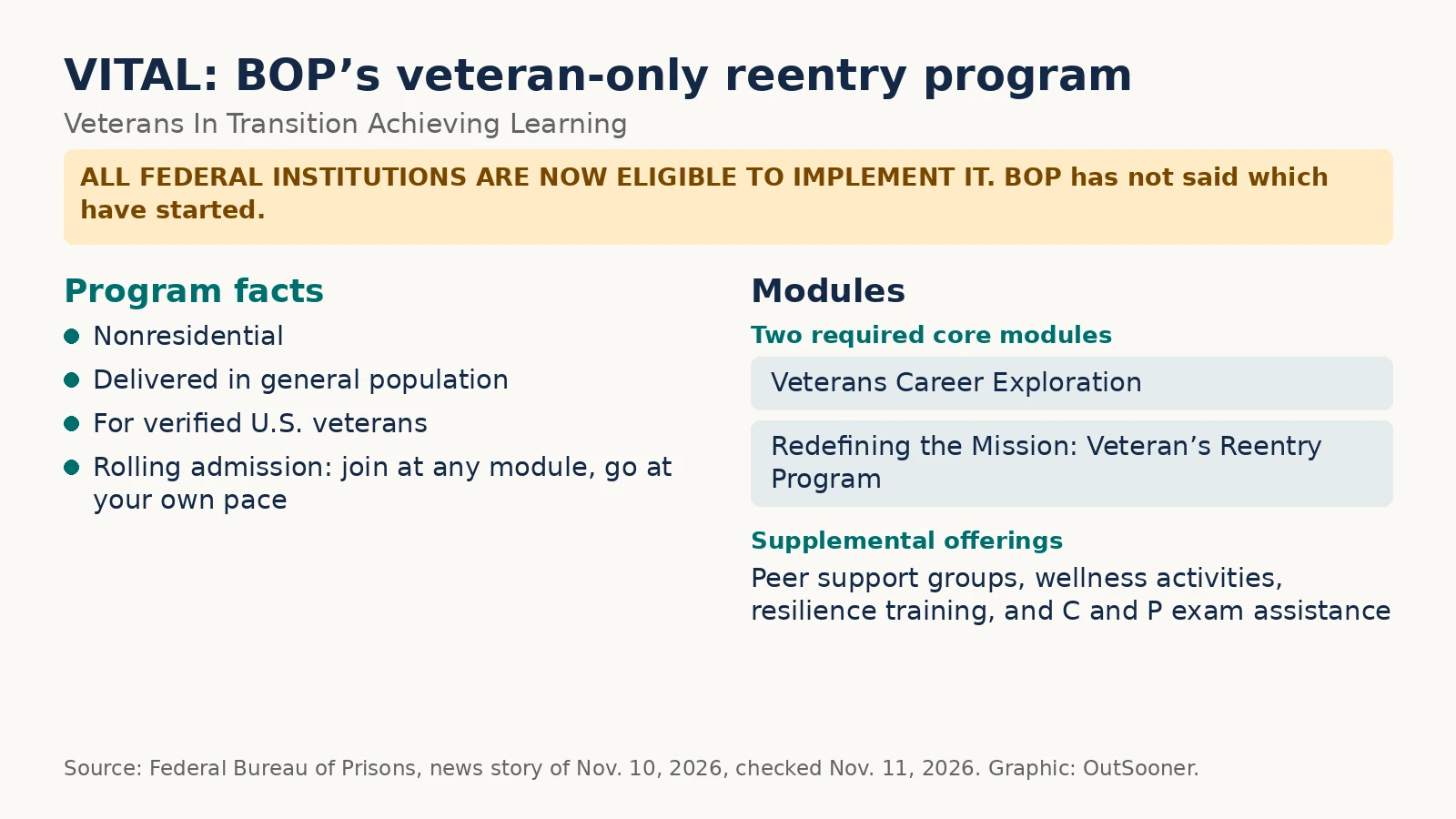
What BOP says VITAL is
BOP's announcement (opens in new tab) says the program is "designed to address the needs of incarcerated veterans and prepare them for successful reentry." Here is what it says about how VITAL works:
- Who it is for. It "empowers verified U.S. veterans" to build on skills from their service while addressing "mental and physical health, employment, benefits access, wellness, and reentry planning."
- Where it is held. The program is "[d]elivered in general population," and BOP also calls it nonresidential.
- How people join. VITAL "uses a flexible, rolling admission model. Participants may join at any module and progress at their own pace."
- Who runs it. "Programming is facilitated by the Special Populations Coordinator or other designated staff, with support from community volunteers and Veterans Justice Outreach specialists, who visit quarterly to assist with VA benefits education and the Compensation and Pension process."
BOP's April 2026 testimony to the Senate Veterans' Affairs Committee, which doesn't mention VITAL by name, says institutions also "facilitate Compensation and Pension examinations to determine eligibility for service-connected benefits."
The modules
According to BOP, the curriculum "includes two required core modules, Veterans Career Exploration and Redefining the Mission: Veteran’s Reentry Program, along with supplemental offerings such as peer support groups, wellness activities, resilience training, and C and P exam assistance."
What this means for First Step Act credits
BOP's announcement says: "Most modules align with approved FSA programs, allowing participants to earn credit while addressing service-related needs." It does not say which modules count, or how much credit any module earns, so don't assume every module earns credit.
We checked BOP's First Step Act Approved Programs Guide (opens in new tab) (August 2026 edition) on Nov. 11, 2026. It lists both core modules by name as productive activities, each marked "May be offered at all BOP institutions." The guide doesn't mention VITAL itself, and a listing in the guide doesn't mean any one person will earn credit. BOP's guide describes productive activities as "supplemental offerings intended primarily for inmates with low or minimum risk of recidivism, though they are available to all inmates."
The basic credit rule is in 18 U.S.C. 3632(d)(4) (opens in new tab). A person earns 10 days of time credit for every 30 days of successful participation in evidence-based recidivism reduction programming or productive activities. Someone BOP rates at minimum or low risk who, over two consecutive assessments, has not increased their risk of recidivism earns 5 more days per 30. Our First Step Act guide has the full background.
Not everyone can earn credits. The statute bars people serving sentences for convictions under a long list of provisions. BOP's First Step Act overview (opens in new tab) describes those offenses as generally violent, or involving terrorism, espionage, human trafficking, or sex and sexual exploitation, and also lists certain firearm offenses and "high-level drug offenses." The statute's list is longer and includes, for example, certain explosives, arson, kidnapping, carjacking and immigration offenses. BOP's list of disqualifying offenses (opens in new tab) gives the full list and says the statute is the official source. Federal law also says a final order of removal blocks applying earned credits. BOP's FAQ (opens in new tab) says people receive credit only for participation in programs and activities "directly assigned to them." Credits that BOP applies can move someone toward prerelease custody, such as a halfway house or home confinement, or toward early supervised release. Earning credits and having them applied are separate steps, and BOP's guide says applying them depends on other conditions, such as a person's risk level.
What the announcement doesn't say
- Which institutions have started VITAL, or when.
- How to sign up, or whether there is a waitlist.
- How a person's veteran status is "verified" for VITAL.
- Which modules earn First Step Act credit, or how much.
- How many sessions each module has.
What families can do
Ask the person's unit team, or the facility's Special Populations Coordinator, whether the prison offers VITAL, how to join, and how veteran status is verified for it. Ask too whether the modules can be assigned or recommended for the person, since BOP says credit is tied to assigned programming.
On verification, BOP's veterans policy, Program Statement 5242.01 (opens in new tab) (April 14, 2022), says unit team staff ask at the initial program review whether a person is a veteran and use documents such as the presentence report "to verify this information, if possible." BOP's April 2026 testimony (opens in new tab) says staff verify service history with documents including presentence reports and military discharge records. Neither says what VITAL itself requires, so ask the unit team what documents it needs.
Using the calculator
OutSooner's First Step Act calculator has no field for VITAL, a module or any other program. Its credit estimator asks for days earning at the base rate (10 per 30), days earning at the minimum or low-risk rate (15 per 30), whether the judge ordered supervised release, and a checklist of offense groups that can bar credits. It tells you to use the days in earning status from the person's FSA Time Credit Assessment. Joining VITAL doesn't tell you either number. The result is an estimate. Only BOP calculates and awards First Step Act credits and sets official dates and placement.
OutSooner is a free information site, not a law firm and not a government site. This is general information, not legal advice. Read more about how OutSooner reports and corrects stories.
Sources checked Nov. 13, 2026, 6:01 to 6:05 a.m. MT: BOP news story "Supporting Incarcerated Veterans Is VITAL!" (marked updated Nov. 10, 2026, 1:13 p.m., no time zone given); BOP First Step Act pages (overview, FAQ and list of disqualifying offenses) and Approved Programs Guide (August 2026); 18 U.S.C. 3632 (GovInfo, 2024 edition; the House Office of the Law Revision Counsel's classification tables list no amendment to it in the 119th Congress through Pub. L. 119-138, Nov. 3, 2026); BOP Program Statement 5242.01; BOP testimony to the Senate Veterans' Affairs Committee (April 15, 2026); Federal Register search for Nov. 6 to 13, 2026 (no BOP documents).
Sources
- BOP news story "Supporting Incarcerated Veterans Is VITAL!" (marked updated Nov. 10, 2026), checked Nov. 13, 2026 (opens in new tab)
- BOP First Step Act Approved Programs Guide (August 2026), checked Nov. 13, 2026 (opens in new tab)
- 18 U.S.C. 3632 (GovInfo, 2024 edition), checked Nov. 13, 2026 (opens in new tab)
- BOP First Step Act overview, checked Nov. 13, 2026 (opens in new tab)
- BOP list of First Step Act disqualifying offenses, checked Nov. 13, 2026 (opens in new tab)
- BOP First Step Act frequently asked questions, checked Nov. 13, 2026 (opens in new tab)
- BOP Program Statement 5242.01, Management of Inmate Veterans (April 14, 2022), checked Nov. 13, 2026 (opens in new tab)
- BOP testimony to the Senate Veterans' Affairs Committee (April 15, 2026), checked Nov. 13, 2026 (opens in new tab)
Rules and fees change. Always check the official source before you send money or travel. Spot a mistake? Report an error.
More help in your state
How we verified this page
- Sources checked: the official sources linked here were last checked on the date below.
- Rules compared: our explanation is compared with those sources. It is not a legal review or legal advice.
- Errors: if anything doesn't match the official source, tell us on the Corrections page.
Sources: How we source and verify · Corrections
Methodology · Data quality · Privacy · Editorial & source review
General information, not legal advice. OutSooner is not a law firm or a government agency. Laws and rules change; check the official source linked on each page before you act. Full disclaimer →